
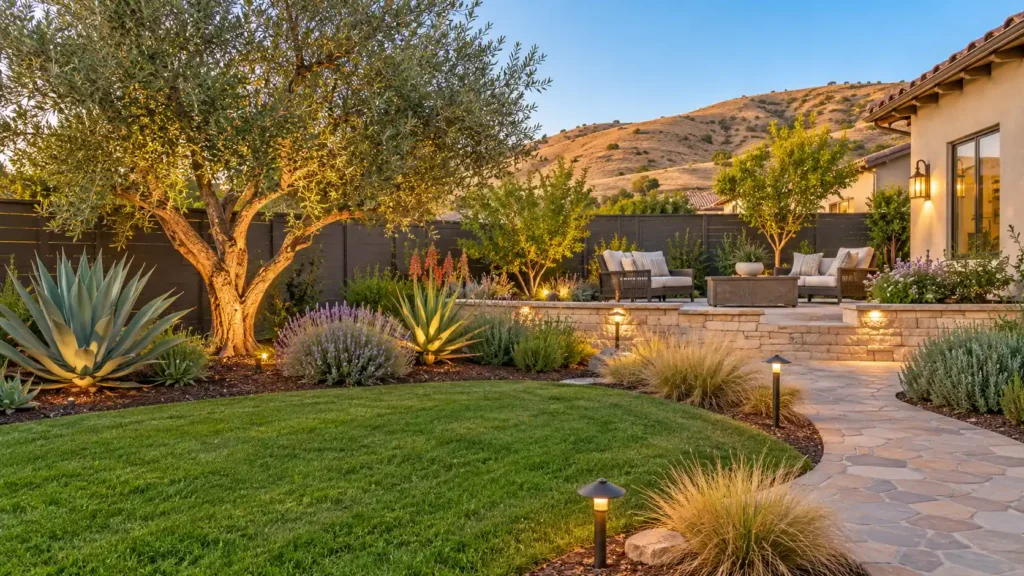
A good Southern California yard works with the climate instead of against it. Long dry summers, strong sun, and the occasional hard rain all shape what grows well, what lasts, and what ends up costing more in water and repairs than it should. Homeowners who plan with those conditions in mind tend to end up with outdoor spaces they actually use, rather than a lawn they feel obliged to keep alive.
This guide covers the main decisions in a water-wise landscape: how to plan the layout, which materials hold up, how to manage irrigation, and what ongoing care looks like.
Quick Answer: What Makes a Landscape Water-Wise?
A water-wise landscape matches plants to the local climate, groups them by water need, uses efficient irrigation, and covers bare soil with mulch or hardscape. It reduces waste without giving up appearance, and it can include lawn, lighting, patios, and walkways. The design, irrigation, and maintenance plan should be considered together, since each affects the others.
Start With the Site, Not the Plant List
Before choosing anything, look at how your property behaves.
Sun and shade. Notice which areas get full afternoon sun and which stay shaded. West-facing walls and paved areas absorb heat and stress plants nearby.
Slope and drainage. Water runs downhill, and hillside lots in particular need thought about erosion and runoff. A good plan directs water where it can soak in.
Soil. Soil type affects how quickly water drains and what grows well. Heavy soils hold water, while sandy soils drain fast.
Existing features. Mature trees, retaining walls, and fences are worth keeping where they serve the design.
How you live. A landscape should fit your habits. If the kids play on the grass, you’ll want durable lawn space. If you entertain, a patio and lighting may matter more.
Choosing Plants for the Climate
Plants adapted to dry summers need less supplemental water once established. Many gardeners across Southern California rely on drought-tolerant shrubs, ornamental grasses, succulents, and native species, mixed with a few thirstier favourites in a limited area.
Some principles help in any yard:
- Group by water needs. Putting thirsty plants next to drought-tolerant ones means one gets too much or the other too little.
- Think in layers. Trees, shrubs, groundcovers, and accents create depth and shade the soil.
- Plan for mature size. Plants that outgrow their spot cost time and money to prune or replace.
- Choose with fire and local rules in mind. In many parts of California, plant selection and spacing near structures are guided by fire-safety recommendations, so check your local requirements.
A local landscape professional can recommend what performs well in your specific area, since conditions vary between valleys, hillsides, and coastal zones.
Where Hardscape Fits In
Patios, walkways, retaining walls, and masonry features give a yard structure and reduce the area that needs watering. Done well, they also extend usable living space.
Good hardscape starts with a solid base. Compacted, properly graded foundations prevent settling and cracking, and drainage planning keeps water from pooling against the house or under paving. Materials matter too. Pavers, natural stone, and poured surfaces each have different costs, looks, and maintenance needs, and a skilled contractor can explain the trade-offs.
Hardscape works best when it’s planned with the planting scheme, so that paths, seating areas, and beds relate to each other instead of competing.
Irrigation: Where Most Water Is Won or Lost
Even a well-chosen planting can waste water if the irrigation is poorly designed. Efficient systems share a few features.
Drip irrigation for beds and shrubs. Delivering water slowly at the root zone reduces evaporation and runoff compared with spray heads.
Right-sized spray or rotor heads for lawn. Heads should match the area and avoid watering pavement.
Zoning. Separate zones for lawn, shrubs, and shaded areas let each receive what it needs.
Smart controllers. Controllers that adjust to weather and season can reduce unnecessary watering.
Regular checks. Broken heads, clogged emitters, and leaks waste water quietly. A seasonal inspection catches them.
If your system is old, an irrigation review is often one of the most cost-effective improvements you can make. Ask a professional to walk the system with you while it runs.
Lawn Decisions
Lawn isn’t automatically a bad choice. It’s a practical surface for play and gatherings, and it cools the ground. The key is to size it for use. Many homeowners reduce lawn to the areas they actually use and replace the rest with groundcover, mulch, or planting beds.
If you keep lawn, choose a grass type suited to your climate and sun exposure, mow at the recommended height, and water deeply but less often so roots grow deeper. Regular maintenance keeps it healthy without constant intervention.
Lighting: Extending the Use of the Yard
Outdoor lighting makes a landscape usable after dark and adds safety along steps and paths. LED fixtures use little energy and last a long time, which makes them a popular choice for accenting trees, lighting walkways, and highlighting architectural features.
Good lighting is subtle. A few well-placed fixtures usually look better than many bright ones, and low-voltage systems are generally straightforward to install and adjust as plants grow.
Buying Guide: How to Choose a Landscape Contractor
| Factor | Why It Matters |
| License and insurance | Confirms the contractor is authorised in California and protects you if something goes wrong |
| Experience | Years in the field and familiarity with local conditions help avoid costly mistakes |
| Range of services | A contractor who handles design, installation, masonry, irrigation, and maintenance can coordinate the whole project |
| Portfolio | Photos of completed work show style and quality |
| Written estimate | An itemised proposal lets you compare scope and cost |
| Communication | Clear, prompt communication prevents misunderstandings |
| References | Past clients can speak to reliability, cleanliness, and follow-through |
| Maintenance options | Ongoing care protects the investment after installation |
One example of a full-service option is Lyle Lavietes Landscape Contractor, Inc, based in Simi Valley, which describes more than 45 years serving Southern California and offers landscaping, hardscaping, irrigation and water management, lawn care, and LED lighting. Whatever contractor you consider, ask to see recent work and request a written scope before signing.
Maintenance: What Keeps a Landscape Looking Good
Installation is only the start. A consistent routine keeps plants healthy and prevents small issues from becoming large ones.
- Seasonal pruning. Prune at the right time for each plant, and avoid heavy cutting in hot weather.
- Mulch. A layer over bare soil reduces evaporation and suppresses weeds. Top it up as it breaks down.
- Irrigation adjustments. Change schedules with the seasons and after rain.
- Weed control. Remove weeds early, before they spread.
- Fertilising and soil care. Feed plants as their type and season require.
- Cleanup. Clearing debris and dead growth keeps the yard tidy and helps with fire safety.
Common Mistakes to Avoid
Planting first and planning irrigation later. The two should be designed together.
Mixing thirsty and drought-tolerant plants in one bed. One group will suffer.
Ignoring drainage. Poor grading can damage hardscape and the foundation.
Overplanting. Plants need room to reach mature size.
Skipping mulch. Bare soil loses water and invites weeds.
Choosing materials on appearance only. Maintenance, durability, and heat absorption matter too.
Neglecting upkeep after installation. A good design still needs regular care.
FAQs
What is a water-wise landscape?
It’s a landscape designed to use water efficiently, with climate-appropriate plants, efficient irrigation, and mulch or hardscape in place of unused turf.
Do I have to remove my lawn?
No. Many homeowners keep a smaller lawn for play or gatherings and replace the rest with beds, groundcover, or hardscape.
Is drip irrigation better than sprinklers?
For shrubs and beds, drip is generally more efficient because it delivers water directly to roots. Lawns still need appropriate spray or rotor heads.
How often should an irrigation system be checked?
At least once or twice a year, and after any visible problem such as soggy spots or dry patches.
Does hardscape reduce maintenance?
It can, since patios and paths need no watering or mowing, but they still need periodic cleaning and repair.
How long does a landscape project take?
It depends on size and complexity. A simple refresh may take days, while a full design-and-build project with masonry can take several weeks.
Can landscaping and lighting be installed together?
Yes, and planning them together is usually easier and more cost-effective than adding lighting later.
Conclusion
A landscape that suits Southern California starts with the site, matches plants to the climate, treats irrigation as part of the design, and builds in a realistic maintenance routine. Hardscape and lighting add structure and usability, while a thoughtful lawn plan keeps water use in check. Choose a contractor who can coordinate the whole project, ask to see past work, and get the scope in writing. With those pieces in place, you end up with a yard that looks good through the dry months and costs less to keep up.