
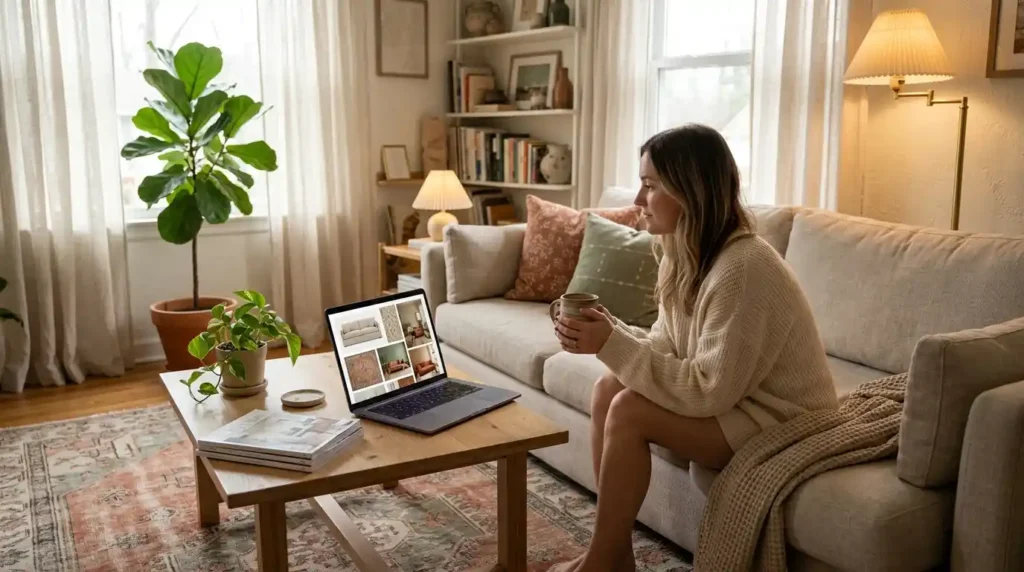
You’ve got the sofa, a pile of paint swatches, and no idea how it fits together. That’s where a virtual interior decorator comes in. You send photos and measurements, and a pro sends back a plan for your room. In this guide, you’ll learn what an online decorator does and how that differs from a designer. You’ll see what it costs and get five simple steps to follow. The main point is easy: online decorating works well for refreshing rooms, and it costs far less than hiring someone to visit your home. It won’t replace a pro if you’re moving walls.
What an Online Decorator Actually Does
Think of an online decorator as a style coach for your room. You never meet face to face. You share photos, room sizes, and your budget, and they build a plan around them. That usually means a color palette, furniture picks, a layout, and a shopping list. It’s a good fit when the walls and floors are staying put and you want the room to feel finished. Here are the two questions people ask most.
What does a virtual interior decorator do?
A virtual interior decorator plans the look of your room from a distance. They choose furniture, colors, rugs, lighting, and decor to match your taste and budget. You get the plan online, often as a design board, a floor plan, and a list of items you can buy. One example is Havenly’s packages, which are priced per room. Some services also add 3D images so you can see the room before you spend money.
Is a decorator the same as a designer?
No. A decorator works on the look of a space, while a designer can also change how it works. An explainer republished by Nasdaq says to pick a designer if you’re removing walls or moving plumbing or wiring. A decorator is fine for furniture, paint, and flooring. Licensing rules vary by state. In some states, “interior designer” is a protected title, while anyone can call themselves a decorator. So check the person’s work, not just the title.
How Much Does Online Decorating Cost?
Online decorating costs far less than a traditional visit. The big difference is how you pay. In-person pros usually charge by the hour. Online services usually charge one flat fee per room. Keep in mind that the fee covers the plan, not the furniture. You still pay for the sofa. Prices also change often, so check each company’s page before you decide. Here’s what the numbers look like right now.
What does a virtual decorator cost per room?
Expect roughly $159 to $199 per room at a service like Havenly, based on its own pages. Premium services cost more. Decorilla, for example, has listed packages from about $549 up to $1,849 per room, according to Virginia Living’s roundup, though that article is older. For comparison, Havenly says traditional designers charge $150 to $300 an hour. Bankrate, citing HomeAdvisor, puts decorators at about $50 to $150 an hour. Most of these figures come from the companies themselves, so treat them as a guide.
Is it worth the money?
For most single-room refreshes, yes. My take: pay for it when you’re stuck on layout or can’t pick pieces that match. Skip it if you already know what you want and only need a few small things. The biggest savings come from avoiding expensive mistakes. A sofa that’s too big for the room can cost more than the whole design fee. A free AI tool is fine for ideas, but it won’t know your budget or your room the way a person will.
How to Work With an Online Decorator, Step by Step
You don’t need design skills to get a good result. You just need clear photos, honest measurements, and a budget you stick to. Most services return a plan in about a week, according to Havenly. The more detail you give at the start, the fewer changes you’ll need later. Here’s how the process usually goes, and what to check before you pay.
How does the process work?
Follow these five steps:
- Set a budget and a style. Pick a number for furniture, and save five to ten photos of rooms you love.
- Send photos and measurements. Include the whole room, plus windows, doors, and outlets.
- Review the first ideas. Look at the layout, colors, and furniture picks.
- Ask for changes. Say clearly what you like and what you don’t. Most packages include revisions.
- Shop the list. Buy in stages, starting with the biggest pieces.
[Site owner: add one short, real story here, like a room you decorated online or a reader’s experience you can confirm.]
What should you check before you hire?
Look at five things before you pay:
- Samples of past rooms that look like yours
- How many changes are included
- Whether furniture is bought through you or separately
- The return rules for items that don’t work
- Whether you get a floor plan or 3D image, or only a mood board
Ask these questions up front. A good service will answer them clearly.
Conclusion
A virtual interior decorator can turn a room you can’t figure out into a plan you can shop. Three points matter most. Decorators handle the look, while designers handle structure. Plan on about $159 to $199 per room at budget services, plus the cost of furniture. And give clear photos, measurements, and a budget. Pick one room to start with, set your number, and compare two or three services. If you’ve tried online decorating, share how it went in the comments. Your experience may help someone else decide.
FAQs
What does a virtual interior decorator do?
They plan the look of your room online. You send photos and sizes, and they send back a design plan, furniture picks, and a shopping list.
How much does an online interior decorator cost?
Budget services charge about $159 to $199 per room for the design plan. Premium services can cost $549 or more per room, and furniture is extra.
Is online interior design worth it?
It’s worth it for a room refresh when you’re stuck on layout or style. It’s less useful if you’re doing major construction, since a designer should handle that.
How long does it take?
Most online designs come back in about a week after you send your photos and details. Revisions and shopping add more time.