
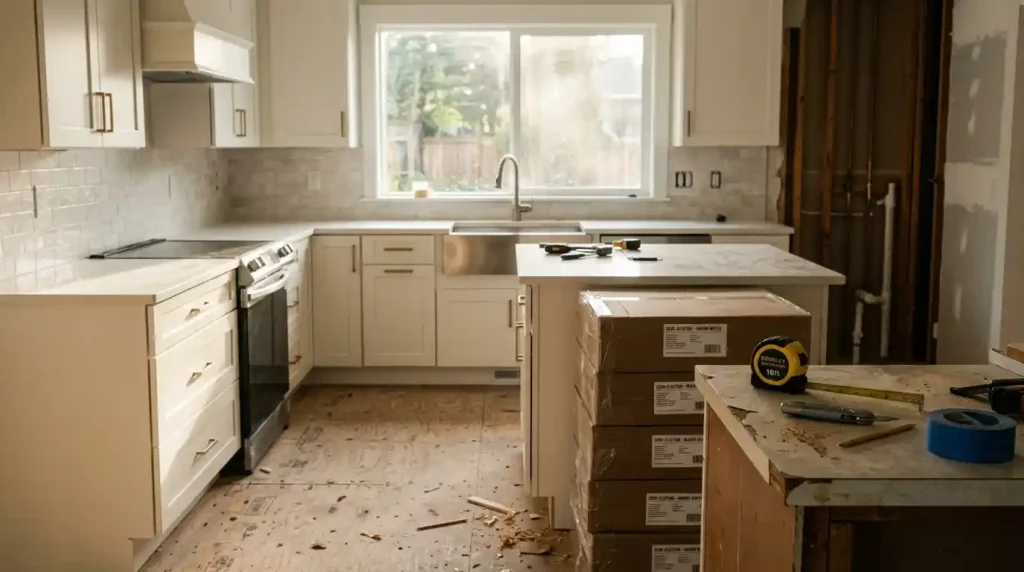
How much does a kitchen remodel cost? Most homes I’ve worked on land somewhere between $18,000 and $150,000 in 2026, and that’s not me hedging, that’s just how differently “remodel” gets used. New counters and a coat of paint is one job. Tearing out a wall and moving the plumbing is a whole different animal, priced like one too. I’ll walk through real numbers here, broken down by kitchen size and by how big a job you’re actually taking on, plus the handful of choices that move your final bill more than anything else. I’ll also flag where the industry cost reports and the homeowner surveys don’t agree with each other, because they genuinely don’t, and it’s worth knowing why before you pick a number to build your own budget around.
How Much Does a Kitchen Remodel Cost in 2026?
Right now the national average sits close to $27,000, going off contractor-reported guides like Angi’s data. That number hides a lot, honestly, and I ran into this myself when a client showed me three different “average kitchen cost” articles that all disagreed with each other. Zonda’s Cost vs. Value Report tracks actual completed projects instead of self-reported guesses. It puts a minor kitchen remodel at $28,458 and a major midrange job at roughly $82,793. Homeowner surveys tend to run higher, usually $32,000 to $35,000, and my guess is that people who fill out a survey about their remodel are usually the ones who added a few extras along the way. Nobody rushes to report on a kitchen where they just repainted the cabinets and called it done. None of these numbers are wrong exactly, they’re just counting different things, so figure out which one you’re actually looking at before you anchor a whole budget to it.
What is the average cost of a kitchen remodel?
About $27,000 nationally right now, though I’d push back on anyone treating that as a real quote for their own kitchen. I tell clients that number is a floor, and only for cosmetic work at that. The second you touch the layout or move plumbing, you’ve stepped into a different category entirely, and the price follows you there.
How much does a kitchen remodel cost per square foot?
$75 to $250 a square foot, and where you land inside that range comes down almost entirely to material choice. Laminate and stock cabinets pull you toward the bottom. Custom cabinetry and natural stone pull you toward the top fast. Run a 150-square-foot kitchen at the midpoint and you’re looking at roughly $24,000, which happens to line up pretty closely with the averages above.
Kitchen Remodel Cost by Kitchen Size
Square footage predicts cost better than almost anything else I’ve seen, but it’s not the whole story. I’ve watched two 150-square-foot kitchens land $30,000 apart, and the only real differences were cabinet grade and whether the layout moved. That said, size still sets the outer edges of your budget in a way nothing else quite does, since it decides how many linear feet of cabinets and counters you’re paying for, how much flooring you need, and how many electrical and plumbing points a contractor has to navigate around. The ranges below held up across the small, medium, and large kitchens I’ve either priced myself or watched get priced, cross-checked against published benchmarks. Take them as a starting frame rather than a quote. Your ZIP code alone can swing labor costs 20 percent in either direction, and coastal metros tend to run even higher than that.
How much does a small kitchen remodel cost?
$18,000 to $34,000 for a kitchen under 100 square feet, assuming a full update on cabinets, counters, and appliances without moving the footprint. Galley kitchens and small L-shapes tend to land right in this range. There’s just less material to buy and fewer linear feet of cabinetry to install, and that alone accounts for most of why this tier stays cheaper than people expect.
How much does a large kitchen remodel cost?
$80,000 to $150,000 or more once you’re past 200 square feet, and an island by itself can push you there. Add expanded seating and premium appliances and the climb happens faster than most people plan for. I priced a 250-square-foot open kitchen last year where the stone island alone added $8,000 to $15,000 in fabrication and installation, before anyone had even touched a cabinet.
What Actually Drives Kitchen Remodel Costs Up or Down
Four categories eat most of the budget. Cabinets. Labor. Countertops. Appliances. Everything else, permits, design fees, contingency, fills in the rest. Cabinets alone usually claim 25 to 40 percent of the whole budget. That number surprises people every time. Most first-timers guess appliances will dominate. They don’t. Labor runs 20 to 35 percent. Countertops, 10 to 20. Appliances, another 10 to 20. And a contingency fund of 10 to 20 percent isn’t optional, not in my experience. It’s the line between a manageable surprise and a stalled job when someone opens a wall and finds wiring nobody knew was there.
Why are cabinets so expensive in a kitchen remodel?
Because they’re material, custom sizing, and skilled labor bundled into one purchase. Going from stock to semi-custom to fully custom can multiply the price 1.2 to 1.5 times for the same footprint, sometimes more. Refacing your existing boxes instead of replacing them outright is the single biggest lever you have here. Cheapest fix on the list, honestly.
Minor, Midrange, and Upscale Kitchen Remodel Costs Compared
Most industry reports split kitchen remodels into three tiers, and I find that a lot more useful than fixating on one national average. A minor remodel keeps the existing layout and appliances and puts the money into cabinet fronts, counters, and finishes. A major midrange job replaces cabinets, counters, and appliances outright, and might nudge the layout a little. Upscale means custom cabinetry, real stone, professional-grade appliances, often a full structural change on top of it all. The gap between these tiers isn’t small, it’s enormous, and that gap is exactly why so many budgets blow up. People picture a midrange kitchen in their head and then, one decision at a time, quietly pick upscale finishes without ever noticing the moment it happened.
| Tier | Typical cost | Typical ROI at resale |
|---|---|---|
| Minor remodel | $28,458 | 96% to 113% |
| Major midrange | $82,793 | 49% to 60% |
| Upscale/luxury | $164,104 | 35% to 50% |
What’s the difference between a minor and major kitchen remodel?
A minor remodel keeps your layout, your appliances, usually your cabinet boxes too, and puts the money into surfaces instead. A major remodel replaces cabinets and appliances outright, moves the layout more often than not. If your kitchen works fine and just looks tired, go minor. Better return, less disruption, same result most days.
How to Get an Accurate Kitchen Remodel Quote
None of the ranges above tell you what your kitchen costs. Only a contractor in your actual space can do that. And even then, the quote’s only as good as how you asked for it. Watched a homeowner once compare a $22,000 bid to a $38,000 bid, thought she’d found a steal. Cheap one spec’d laminate. Expensive one spec’d quartz. Not the same kitchen, not even close. That’s not a comparison. It’s two projects wearing one price tag.
How many quotes should you get for a kitchen remodel?
Three, minimum. Itemized, every time. Cabinets, countertops, labor, permits, each broken out separately, never one lump number. A lump sum hides where a contractor’s cutting corners or padding margin. You want to see it, not guess at it.
Is a Kitchen Remodel Worth the Cost? ROI and Resale Value
Kitchens rank among the better-performing remodels for resale, though how much better depends entirely on which tier you picked. Zonda’s data shows minor remodels recovering 96 to 113 percent of their cost at resale, which is one of the strongest returns the report tracks for any project. Major midrange remodels come back down to earth at 49 to 60 percent. Upscale lands lower still, around 35 to 50. I’ve seen this exact pattern hold across several years of reports now, and it always surprises clients: the smaller, smarter update beats the expensive overhaul on pure dollars back, even though the overhaul is obviously the nicer kitchen to actually cook in every day.
Does a kitchen remodel really pay for itself at resale?
Minor ones often come close, frequently over 90 percent recovered. Major and upscale remodels land closer to half. If resale is your main reason for doing this at all, minor is almost always the smarter call financially.
Conclusion
There’s no single number for what a kitchen remodel costs. Just a range that narrows fast once you know your size, your tier, your must-haves. Start with the tier your kitchen actually needs, not the one that looks good on a renovation show. Dated but functional usually means minor remodel, not gut job. Get itemized quotes. Build in a real contingency. Compare bids on scope, not the bottom line alone. Do that and your number will hold up a lot better than whatever a free online calculator spits out.
FAQ
How much does a kitchen remodel cost per hour?
Depends on the trade. Electricians and plumbers run $65 to $150 an hour. General contractors often bill 10 to 20 percent of the total project instead of a flat hourly rate once a job’s big enough. Cabinet installers usually price by the linear foot, not the hour.
How much does a small kitchen remodel cost in 2026?
$18,000 to $34,000 for a full remodel under 100 square feet, assuming the layout doesn’t move. Costs jump fast the second plumbing or electrical needs to relocate.
Is a kitchen remodel worth the money?
For resale alone, minor remodels are one of the best-performing projects out there, often recovering 90 percent or more. For everyday living, most homeowners say yes anyway, even when the resale math is weaker, because you use a kitchen every single day.
How long does a kitchen remodel take?
Two to three weeks for a minor refresh. Six to ten weeks for a major midrange job. Add a layout change or a cabinet backorder and you’re looking at three months plus, easy.